INCREASING RESIDENTIAL DEVELOPMENT
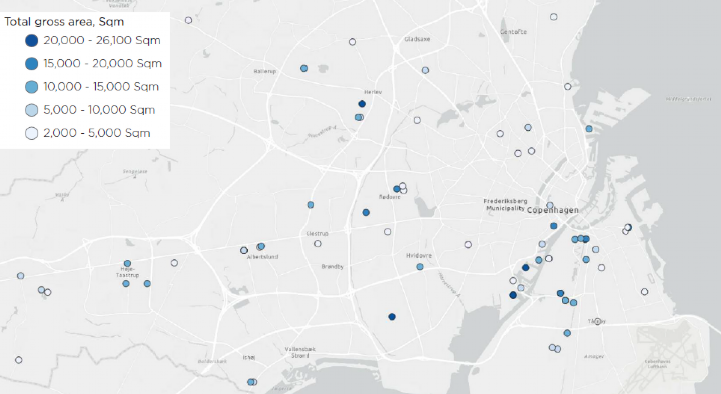
The expected pace of new residential development is increasing significantly in both Copenhagen and the Copenhagen suburbs. The current development pipeline for 2027-2028 amounts to approx. 700,000 sqm, representing an increase of 27% compared to the corresponding pipeline for 2026-2027, estimated one year ago. Copenhagen accounts for approx. 354,000 sqm comprising 5,169 units. This represents an increase of 28% compared to last year’s pipeline and is 2.5 % higher than the approx. 346,000 sqm expected in the Copenhagen suburbs.
A significant proportion of the anticipated development in Copenhagen relates to major projects scheduled for completion in 2028, including Fælledby, Bryggens Bastion and Stejlepladsen, where former natural and industrial areas are being transformed into new residential neighbourhoods. The stronger growth in Copenhagen’s development pipeline compared with the Copenhagen suburbs challenges the expectation that limited access to development land will increasingly shift residential construction towards surrounding municipalities. However, Copenhagen’s continued appeal means that new development opportunities within the city attract considerable interest from both developers and investors whenever political decisions permit residential development.
RENT LEVELS CONTINUE TO RISE
Residential market rents increased across all Copenhagen districts and in the Copenhagen suburbs during 2026, with growth ranging from 1% to 11%. The central districts retain their position as the most attractive locations, commanding the highest market rents, with prime rent levels of up to 3,800 DKK/Sqm/year for smaller flats and 2,700 DKK/Sqm/year for larger flats. Across flat sizes, prime market rents in Frederiksberg and the Copenhagen districts CPH K, CPH Ø, CPH V and CPH N increased by 8.81% in 2026, representing the strongest rental growth across the Copenhagen districts. In Ørestad, rental growth has been more moderate at 4.39%. This should be viewed in the context of the area’s ongoing residential development and the continuous addition of new housing units. Rental growth has generally been strongest among smaller flats. In the Copenhagen suburbs, market rents for smaller flats recorded the highest increase at 9.18% across the prime and secondary segments. By comparison, market rents for the largest flats have increased by an average of 2.68% across the districts. The stronger rental pressure on smaller flats may reflect the fact that high rents for larger homes limit the options available to a wider group of tenants, thereby increasing demand for smaller homes with lower overall monthly rental costs.